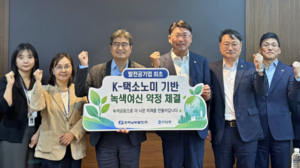


[소셜밸류=박완규 기자] On the 3rd, ASET (CEO Park Seok-jeong), a startup specializing in solid-state electrolyte membrane for next-generation secondary batteries, announced that it has been designated as a ‘First Penguin’ company.
First Penguin program is an innovative startup scale-up initiative by Korea Credit Guarantee Fund, providing up to 4 billion KRW in guarantee support along with various non-financial assistance.
Following its designation under the Startup Nest Program in 2024, ASET has been receiving consistent and structured support for growth, starting with initial scouting and the issuance of guarantees by the Korea Credit Guarantee Fund’s Incheon Startup Branch, followed by technology commercialization guarantee support for technology transfer projects, and direct investment.
In particular, Incheon Startup Branch played a crucial role in laying the foundation for ASET’s scale-up by identifying its technology strength and growth potential at an early stage. All of this support, including its designation as a ‘First Penguin’ Company, now serves as the cornerstone for its technology commercialization
Additionally, the designation also adds value, as it can be recognized as an official acknowledgement of the potential for the commercialization and global expansion of ‘solid-state electrolyte membrane technology’ for next-generation secondary batteries.
Now, ASET aims for mass production and market entry by expanding solid-state electrolyte capacity (over 10 tons), establishing a mass production line for multilayer coating & slitting, and conducting PoC and supplying samples to global OEMs.
The CEO, Park Seokjeong, said, “Full-scale support by Korea Credit Guarantee Fund including initial scouting by its Incheon Branch, the Startup Nest Program, technology commercialization guarantee, direct investment, and ultimately the First Penguin designation, has become an engine behind AEST’s technology commercialization. We will lead the era of safe and high-performance batteries through the mass production of solid-state electrolyte membranes and entry into the global market.”
Meanwhile, AEST has developed a multilayer solid-state electrolyte membrane based on LLZO, significantly improving the fire safety and its performance compared to the PE/PP separators used in traditional secondary batteries.
Thanks to its ceramic-based flexible electrolyte membrane, it is compatible with existing battery production lines. As a result, demand for this technology in various next-generation automation markets, such as electric motorcycle, energy storage system, automotive electronic components, e-mobility and humanoid robots, is rapidly increasing.
[ⓒ 사회가치 공유 언론-소셜밸류. 무단전재-재배포 금지]